August 12, 2026
Proxmox Backup Server and Guest Recovery Limits
Why PBS is the VM-level backup target in this homelab, how its deduplication and incremental backups work, and the guest recovery limits that keep it from replacing application backups.
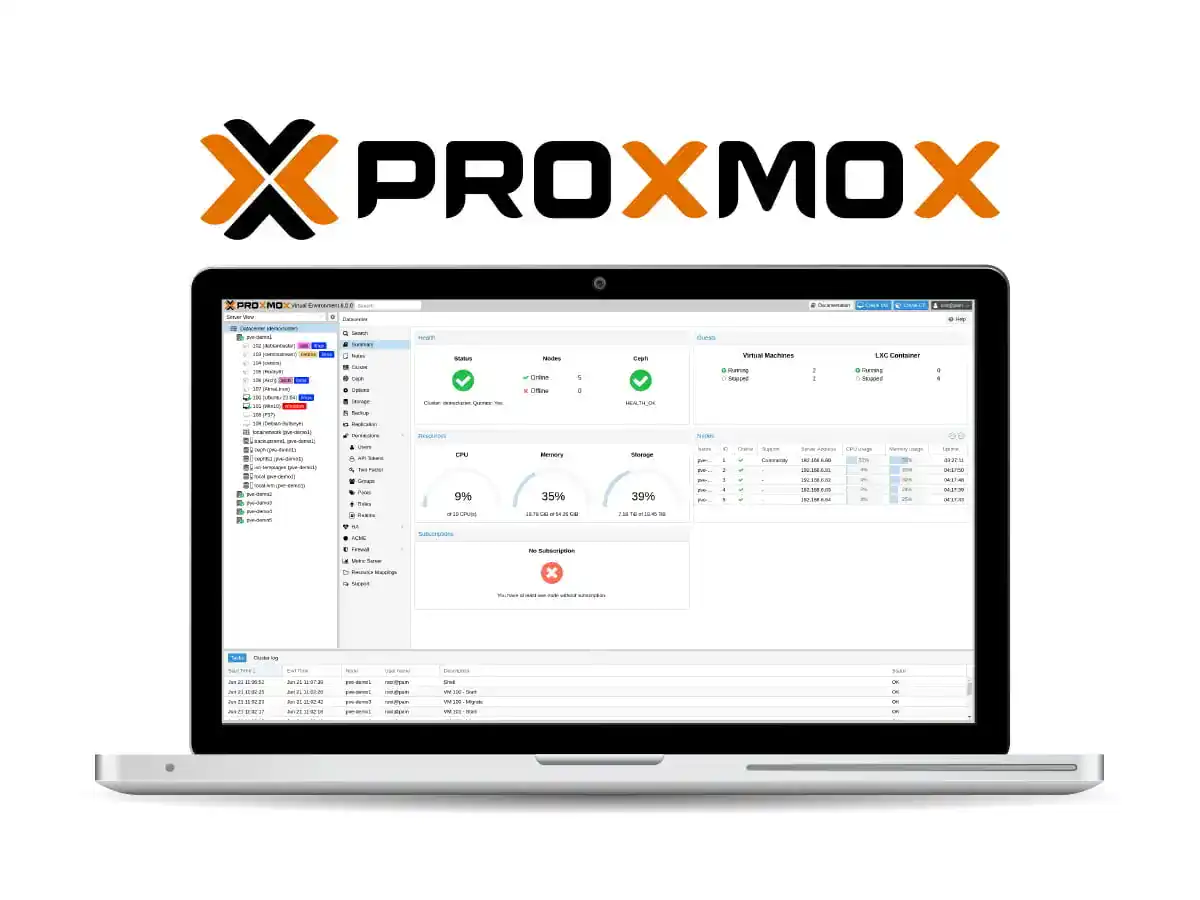
Proxmox Backup Server (PBS) is the backup layer of this homelab. Once Proxmox VE (PVE) became the main virtualization layer, the next step was making sure every VM had a backup without building a separate backup mechanism inside each service. PBS fills that role as the VM backup target. This centralizes backup storage and operations in a dedicated service while applications keep running inside their guests.
Why VM-level backups
PBS backs up an entire VM as one unit. A single job covers services running inside the guest without installing an agent in every application, and recovery happens at guest level rather than as an individual export from each app. PVE documentation states that backups are always full: they include the VM/CT configuration and all data.
Architecture: deduplication, incremental, encryption
The PBS stack is written in Rust for speed and memory efficiency. Backups are sent incrementally to the server, then deduplicated on the server side, so only the delta crosses the network and storage is not wasted on repeated data.
Data is stored as chunks. For file archives, PBS uses dynamically sized chunks with a rolling hash (a Buzhash variant): chunk boundaries follow content instead of fixed positions, so a resized file does not invalidate many chunks and deduplication stays effective. Compression uses Zstandard, and encryption uses AES-256 GCM on the client side, with transfers over TLS. SHA-256 checksums are attached to the data as an integrity guard.
Setup and verification
PBS is installed with the official installer ISO. After installation, create a datastore on an external disk, register PBS in PVE as a storage of type pbs, then configure backup jobs, retention (prune), verification, and notifications from the GUI.
proxmox-backup-manager versions
systemctl is-active proxmox-backup proxmox-backup-proxy
proxmox-backup-manager datastore list
These commands check the version, services, and datastore after installation. Putting the datastore on an external disk separates backup media from the protected VM disks, but does not remove the risk of a single-site failure.
Operations: verification and garbage collection
Verification runs through scheduled verify jobs that check whether backups still match the recorded checksums. The documentation recommends a routine job for new snapshots plus a full re-verification at least monthly, because bit rot can corrupt older backups that were previously healthy.
Prune only removes snapshot metadata, not the underlying chunks. Garbage collection (GC), which frees unused chunks, is recommended on a weekly schedule. Results of verification, GC, and sync can be delivered through notifications. Verify jobs that start failing can also be an early signal of ransomware encrypting backups — useful as an extra alarm, not as a guarantee.
Guest recovery limits
This is the part that matters most. A VM-level backup promises whole-guest recovery, but the limits are real:
- Single-file restore is not always possible. In PVE, File Restore is only available for PBS storage. For containers, the
pxararchives can be browsed freely; for VMs, only supported guest filesystems and partition layouts are accessible — some data may simply be unavailable. Access happens through a temporary VM that stops itself after a timeout. - Consistency depends on the backup mode and guest agent. Snapshot mode backs up a running VM with a small inconsistency risk; consistency improves when the QEMU guest agent is enabled (fsfreeze/thaw). Stop mode offers the highest consistency at the cost of short downtime. Restoring a guest therefore does not prove the transaction consistency of databases inside it.
- Single failure domain. The external disk shares the physical location with the host; it protects against one failing disk, not against losing the whole site.
- Restores need testing. The documentation advises restoring to a new guest rather than overwriting the current one, and scheduling these tests or sampling them periodically.
Conclusion
PBS is a strong VM-level backup layer: one job per guest, storage-efficient deduplication and incremental backups, built-in encryption and verification. But it is not a replacement for application backups — the guest recovery limits (constrained file-level access, consistency tied to the snapshot moment, and single-site storage) define how far this backup can be trusted. For a one-machine homelab, PBS solves the “every VM has a backup” problem, while an offsite copy and restore tests still need separate work.